
It’s been a month since I came back from a completely unplanned trip to Serbia. Besides all the very emotional events that still need to “settle” before I can write about them, the main aftertaste that has stayed with me since my first day back is the sheer amount of nonsense, not to say absurdity, that people down there throw at you.
This isn’t the first time I’ve been shocked by other people’s comments or questions, and I wrote about it in an earlier post where I dealt with the remarks people make about Sofia and to Sofia directly.
I get that we’ve been living abroad for a long time now and that we’ve forgotten, and repressed, a lot of things, but we’ve also adopted a lot from the culture here (because it’s easy to get used to good things, right?). But everything has its limits, including human, not to say cultural, stupidity.
People feel the need to comment on absolutely everything and to busy themselves with other people’s lives more than their own, and that’s just how it is down there. I haven’t discovered America here, I know. People also complain about absolutely everything, yet nobody takes responsibility for their one and only life and their own actions. That’s the kind of people we are, I guess. I’m aware of all that.
What actually bothers me in all of this is the commenting and the outrage over things and life decisions that are completely normal to us.
But let’s start from the beginning.
This was the first time I’d traveled alone, without Marko and Sofia, which wasn’t our choice: we were forced into it by the German authorities (yes, we still haven’t sorted out our status here, can you imagine).
The reason I had to travel so suddenly was anything but nice, so I secretly hoped I’d manage to avoid all the usual clichés aimed at someone who hasn’t lived in Serbia for ages.
I hoped, and that’s as far as it went. Reality proved me wrong, for the umpteenth time.
This time, the most common question after why I’d come alone without my husband and daughter was so who’s watching your child?
I understood it as the implicit question what kind of mother leaves her young child at the mercy of who knows whom and comes here to gallivant around on her own?
Hold on, if I came without Marko and without Sofia, isn’t it only logical that Marko, who happens to be her father, is looking after not my child but OUR child?!
Yes, to me that’s normal, but not to others.
The question that followed my answer, that Marko’s looking after her, who else, was always but will he know how? and who’s helping him?
I don’t know how to describe my shock, which repeated itself again and again, because, as I said, I got that absurd string of questions more than once.
And no, nobody asked me whether it was hard for me that they weren’t with me, how I was coping with being separated from Sofia for more than a day for the first time, or how hard it was for the two of them not to be able to be there.
Maybe the problem is me.
Maybe it’s unrealistic and unfair of me to expect my life choices, and the life the two of us have built to our own measure, means and needs, to be what’s considered representative and acceptable to others. No, I don’t want to impose anything on anyone. Everyone has a choice: to choose their partner, to choose how to raise their children, to choose how to organize their own life.
Our life clearly doesn’t fit the mold of the majority, and to be honest with you, I’m very proud of that.
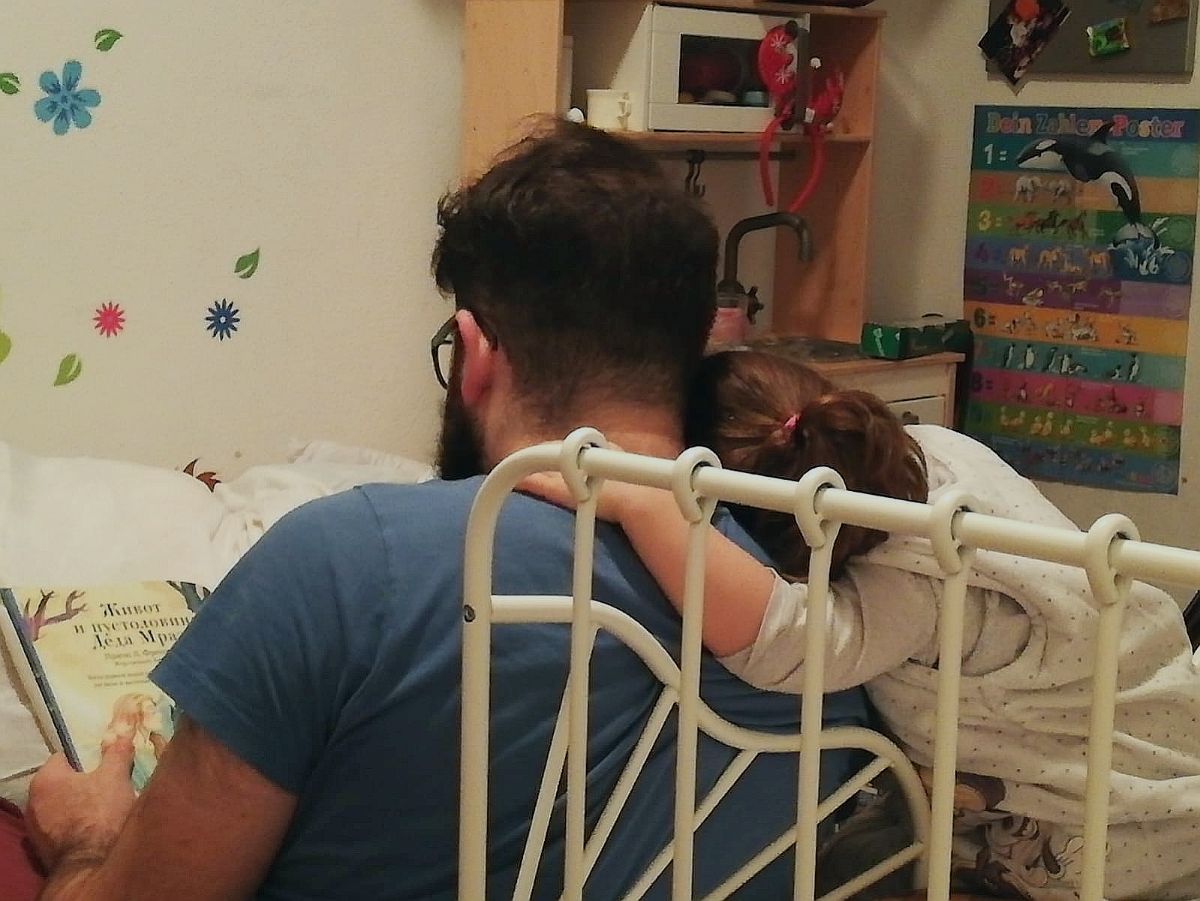
From the very first day of our relationship, and later our marriage, Marko has given everything his all. First me, then our shared home, then Sofia. He’s devoted and selfless when it comes to his family. He’s the head chef in our house, and I’m never embarrassed to admit it, far from it, I’m proud of it. In our house there have never been men’s jobs and women’s jobs, we’ve always done everything together. Literally everything.
So hold on, if Marko can wash the dishes, cook and clean the house, why on earth wouldn’t he be able to take care of his own child by himself?
Which, of course, brings us to the underlying assumption of what a man is allowed to do, able to do and supposed to do in his home and for his family.
Well, we don’t fit the mold there either. Imagine: besides fixing everything around the house himself, he knows how to take care of it and likes doing it, not by putting his feet up and nagging about everything that’s dirty, but by sorting it out himself or together with me. Unbelievable, right? Well, not really.
To us, all of this is completely normal, and how abnormal it is to others we only realize when someone from the Balkans comes to visit and starts being scandalized by how we function and everything he actually does around the house. I’ve heard the sentence oh, lucky you, what a husband you have more than a few times.
Yes, I know, lucky me, and I thank God every day for having him just the way he is. But I won’t be falsely modest here, because my husband never misses a chance to answer that kind of remark with well, since I have a perfect wife, I have to be a perfect husband. It’s not about perfection as such, it’s that we both feel the need to answer such remarks with exaggeration. Neither of us is perfect, and neither of us is trying to be.
That’s how things work with us: we’re not subordinate to each other, we’re partners, equals, and even when we make mistakes, we make them together.
Don’t forget that we live here without a big extended family that could jump in whenever we feel like it. Of course my Ana is a huge help and support to us, but she’s a student here, she has her own life and her own problems, and it’s unrealistic to put her in a position where she has to drop everything and show up every time we happen to need her. We try to bother and burden her as little as possible, because Sofia is first and foremost our child, we wanted her and we take care of her. Simple as that.
So it certainly wasn’t easy for Marko, spending a week alone with Sofia and Beni and all his other commitments. But he handled it like a king, without a single word of complaint. Just like I’ve done many times when he had to travel for work on his own. And imagine, back then nobody wondered how I’d manage alone, whether I’d know how, or whether I had someone to help me.
That’s what bothers me in this whole story. Double standards. Forcing people into molds. The tutting and eye-rolling at anything even slightly different. Outdated, long-overcome prejudices that are, oh, very much alive. That’s what hurts me, because, my dears, having the internet, new phones and who knows what other wonders of the 21st century doesn’t mean you’ve moved past the Middle Ages in your attitudes and behavior.
Warmly,
S-Mama


Leave A Comment