
While reading the latest book by one of my favourite authors, “Lieben” by Emilia Roig, I came across a quote that hit me deeply and made me not only think, but also sit down and write the post you are reading now.
Emilia says:
“Whoever runs from pain also runs from healing” and also “the healing of pain lies in the pain”. (p. 60, “Lieben”, Emilia Roig)
And that got me thinking.
My whole childhood I was “protected” from pain and sadness, even though, in the circumstances, the time and the place where I grew up, they were all around me.
My parents wanted to protect me, and to a great extent they succeeded, and I am endlessly grateful to them for that. I never felt poverty or the horror of the wars raging all around us. I never felt threatened or unloved, even though so many times, when I wanted a sweet or a toy, I heard “unfortunately, we can’t afford that”.
I had a happy childhood.
But on the other hand, that overprotection also left me unequipped to deal with pain and difficult situations as an adult.
The first big crash came when my grandpa died, then the next one, which I still haven’t healed from, when my grandma died. I was very close to both of them, to each in their own way. To my grandma especially. It’s the sixth year without her, and it seems to hurt just as much as on the first day.
I learned to live with pain and loss, or rather, I managed to successfully sweep it under the carpet “because I’m strong”.
“Successfully”, until it erupts to the surface like a volcano and I end up in tears and sobs, triggered by a book, a song, a memory.
The last time I “fell apart with pain” over how much I miss my grandma was a few weeks ago, while I was reading “My Grandmother Asked Me to Tell You She’s Sorry” by Fredrik Backman. The book is so beautiful on so many levels… It’s about the relationship between a grandmother and her granddaughter, about loss, the beauty of imagination and celebrating difference. A big must-read for everyone!
Anyway, I held up well for a good part of the book, letting the odd hidden tear fall here and there, until one evening a very emotional scene in the book coincided with a song playing on the radio, “One Man Can Change the World” by Big Sean (in which he also talks about his grandma, how strong a woman she was and how much he misses her, and which ends with her parting words).
And that was the end of me.
I sobbed so hard, like a little child, it seemed to me. So much pain came out of me that it is hard to put into words. Marko sat next to me, held me and waited for it to pass. And I am grateful to him for that. When the wave had passed and the storm had calmed, I felt lighter.
Only the next day, over coffee, did he say to me, very carefully:
“You know, I’ve been thinking, maybe all that pain and sadness that came out of you last night is actually the generational pain of all your female ancestors, who probably had to suppress their needs and feelings their whole lives.”
Marko at his best, as always.
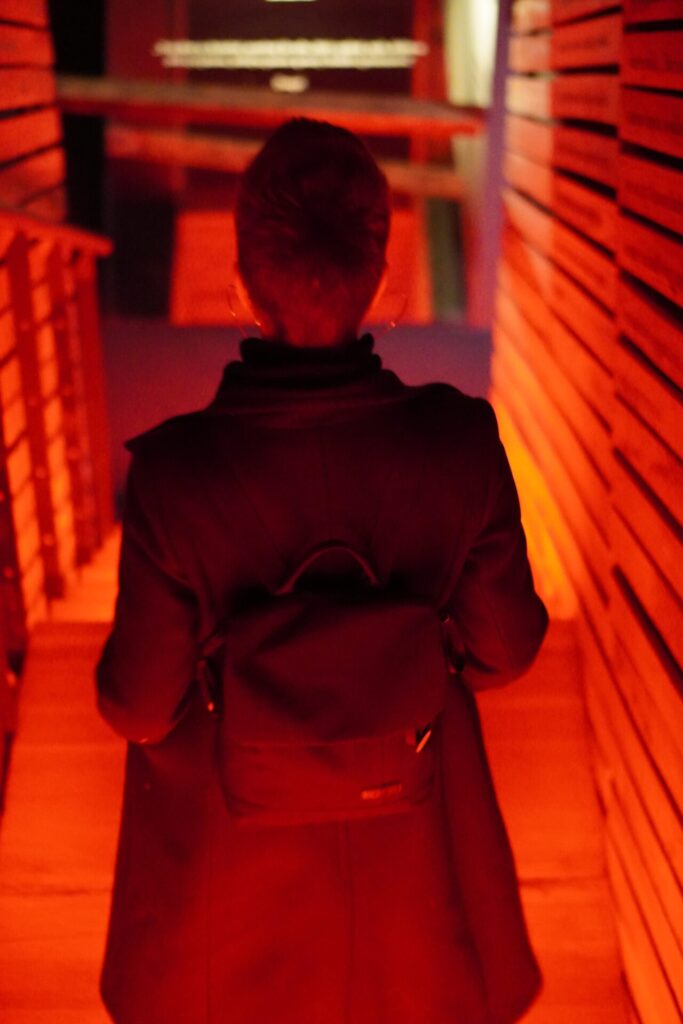
And that pushed me even further into self-reflection.
The theory that emotions, behaviours and, above all, traumas are passed down from generation to generation is neither new nor unfamiliar to me. But it is something completely different when it happens to you, when you feel it first-hand and channel it.
For far too long we have been taught to suppress sadness, dissatisfaction, frustration. For far too long we women have been pushed aside and not taken seriously. All of that is written somewhere in our DNA.
And maybe I am the one who will break that generational chain and free not only myself and my female ancestors, but, most importantly of all, all the women who will come into this world after me, Sofka above all.
Clearly, that realisation shook me to the core.
Yes, it hurts and it will hurt. But I have to learn to feel all my feelings.
And in today’s world that isn’t easy for us women, and, God knows, not for men either. We have grown so attached to the roles we are currently playing in life that we hardly ever question them. We learn to play them from the day we are born, through upbringing and socialisation, and most of all by copying the people around us.
As much as I would like to believe that the world has changed, I very often have to remind myself that yes, yes, it is changing, but not enough and not fast enough.
Because every time “mum has to be strong so that the child doesn’t see that she is sad, shaken or angry”; every time “dad mustn’t cry, even though he has lost someone very important in his life, because it’s shameful when men cry”; every time a little boy falls, hurts himself, starts crying and is told “you’re crying like a girl”, we as a society signal to whoever is having a strong emotional reaction at that moment:
“No, what you are feeling is not acceptable, and because I feel uncomfortable not knowing how to react or how to help you right now, the only possible solution is for you to stop feeling what you are feeling.”
And so we don’t allow ourselves to feel. Instead, like in the animated film “Inside Out 2”, we put our basic emotions in a jar. And if we can lock them away in some hidden safe as well, all the better.
Life is a series of pleasant and unpleasant events, and even though the media, especially social media, surround us with an illusion of perfection and nothing but positivity, that doesn’t mean painful things won’t happen.
But the solution is not to pretend they aren’t happening and play at being machines for the sake of appearances and showing “strength”.
Quite the opposite.
In fact, I am sure that whoever has learned to recognise, accept and let go of their feelings, whoever allows themselves to feel and experience them, can also heal and move on.
And that is exactly what I hope our children will learn to do. At least we are trying to teach Sofia that. Whether we have succeeded, time will tell… But I hope she is at least on a pretty good path.
Time heals everything, that’s true, but not the way we thought: suppress it and it will pass.
Time heals wounds faster when they are treated with care.
A simple example: if you break your leg and can’t walk, you can’t just grit your teeth and wait for it to heal. Even if you could, in theory, block out that amount of physical pain, once it heals, it will heal crooked, and it’s questionable whether you will ever be able to run again.
It’s the same with feelings. And it’s time we took them seriously, because even though they aren’t tangible, they are an essential part of us.
I really am better, and the proof is a dream I had a few nights ago.
Usually, when I dreamed of my grandma, I woke up very shaken, because in my dreams she always begged me to help her and I never managed to save her. And then I would wake up with the pain of loss, with missing her, plus the guilt of not having been able to help her.
But this time it was different.
I dreamed of her laughing, calling me “my sunshine” the way she always did when she was alive, and giving me a sun-shaped necklace. She was happy and smiling.
And I woke up in the middle of the night with a revelation: “I should be glad when she ‘visits me in my dreams’, because dreams are the only way to meet her again, not grieve over it.”
And that set me free. So much so that I can write these words without any trouble, and not once did my chin tremble or my eyes fill with tears.
That doesn’t mean I don’t miss her anymore, quite the opposite.
But I think I have finally let go.
So Emilia Roig is definitely right: “If you run from pain, you run from healing.”
Let yourself feel.
Warmly,
S-Mama


Leave A Comment