
Every parent wants what’s best for their child. But how often do we load our own wishes, and the expectations of the people around us, onto them, and then push those onto our kids? And how much do we actually listen to what they want and need?
Marko and I try to impose as little of our own preferences and habits on Sofia as possible, but I’m not sure how successful we actually are at that — especially when it comes to our love of books. Guilty as charged. We admit it, and we don’t feel even a little bit sorry about it. Marko passed on his fascination with the universe and celestial bodies to her, and I passed on mine for cartoons. Still, a child doesn’t live in a vacuum, right?
But she isn’t a copy of us. She’s very much her own person, and we try not just to support that, but to actively listen to her. Dinosaurs, for example, are entirely her own passion, one she’s passed on to the rest of us.
But when is the right time for parents to actually start listening to their children’s own wishes when it comes to extracurricular activities?
By this I don’t mean daycare, playing with neighborhood friends, trips to the playground, or anything like that. When I say extracurricular activities, I mean sports, dance, language lessons, or other private lessons that have nothing to do with home, school, or daycare-related activities.
Before Sofka and I talked about what she’d like to do or learn, I first talked to her pediatrician. I didn’t want us to start anything too early, but on the other hand, not too late either (if there even is such a thing, since Marko and I are firm believers in lifelong learning).
Once we got the green light from the pediatrician that between ages 5 and 6 is the optimal window for exploring additional interests, we started giving Sofia ideas of things she could try, and told her she genuinely didn’t have to do any of it if she didn’t want to.
First attempt — unsuccessful
Since Sofka’s cousin on her aunt’s side does dance, Sofka first wanted to try that discipline — kids naturally find whatever the older kids do interesting. Luckily, Ana’s friend teaches ballet classes for children, so Sofka said she wanted to try ballet together with her aunt, and of course we made that happen.
But she got bored pretty quickly and didn’t want to go anymore. She said: “It’s fun, but I can’t keep going there.” That was enough for us, because we never wanted to force her into anything.
The whole point of these extracurricular activities is for the child to actually enjoy them, not to have them doing something “by force” from a young age.
So her dance career has been paused indefinitely, or permanently — depends on Sofka.
And so we went back to letting her come to us with an idea, whenever she’s ready for one.
Second attempt?
Music is a big part of our everyday life. Even though neither Marko nor I have any real talent or knowledge when it comes to it, music has a very important place in our lives.
Last summer, when we were in Serbia, Sofia asked me the following question in the middle of playing:
“Mama, how is music made?”
I tried to answer as best I could within the bounds of my very limited knowledge on the subject. And then came the follow-up:
“When we get home, will you please take me so I can learn to make music?”
She didn’t say she wanted to play an instrument, or sing — she said to learn music, in those exact words.
So what else could I do but dive straight into research. So, I needed a school that teaches what she’s interested in. And I found, right in the city center, a Music Academy offering a so-called Musical Education program for kids Sofka’s age. Perfect.
It’s a course that teaches children the basics of music through play — getting to know instruments, notes, tones, and so on. So the point isn’t to shove an instrument into a child’s hands right away, but to give them a foundation for eventually choosing one, a year or two down the line.
Naturally I was thrilled with the concept, but I’m obviously not the one who’ll be attending the classes, right? So it made sense to take Sofka to a class where she wouldn’t just watch the concept and the other kids, but also get the chance to actually participate herself, and decide at the end whether she’d be interested in coming back.
Honestly, after the first class — whether because of the kids she didn’t know, or just something new and unfamiliar in general — she said she really liked it, but that she wasn’t coming back. And I let it go. Luckily, the classes are once a week, so there’s no risk of overloading kids, and she had plenty of time to let her impressions settle.
So two days before the next class, she came up to me and asked — mama, when are we going to music again? That’s when I knew that was it, and that I needed to take her again. After that, she never doubted her choice again. She got to know the other kids and relaxed a lot, the teacher is very warm, and all of that added up to Sofka asking every single day when it’ll be Thursday again, so we can go to music.
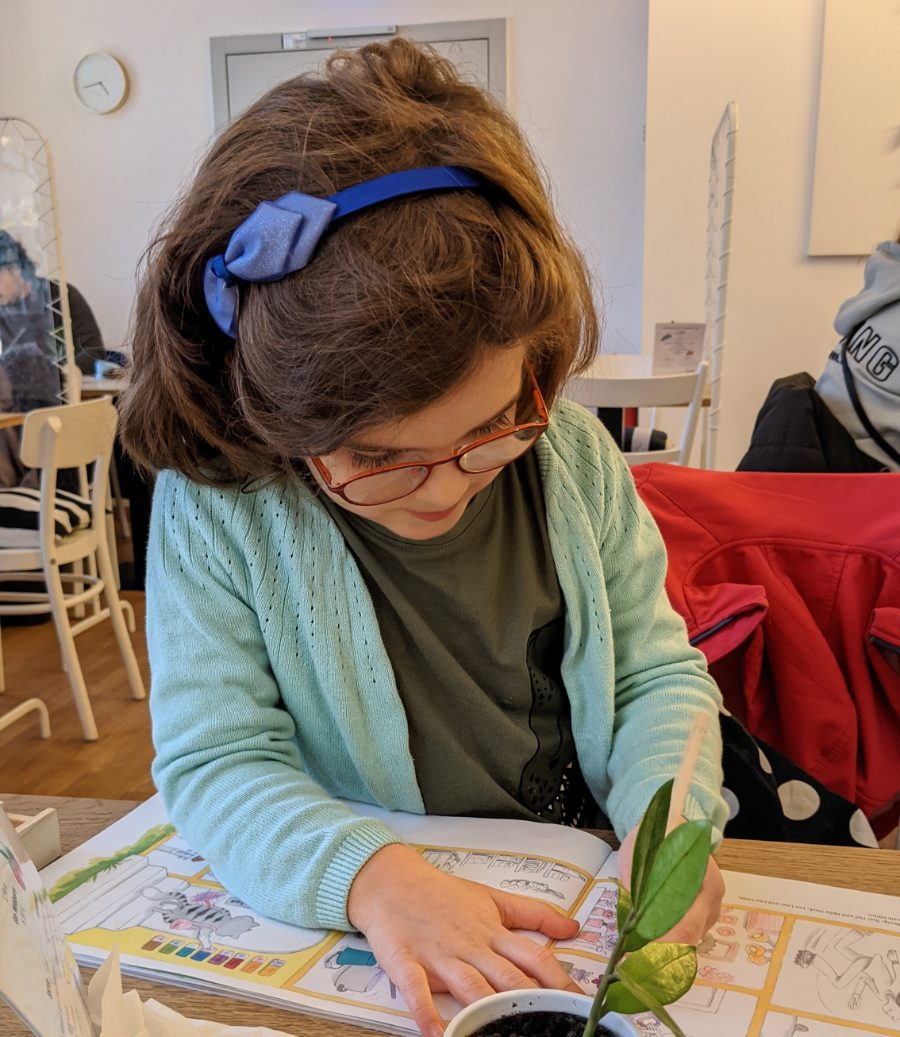
As far as I’m concerned, as her parent, what matters to me is that she does what she actually enjoys and loves. At this age, it matters to me that she’s not overwhelmed, so it’s great that classes are only once a week. And if she loses interest again and says she doesn’t want to do it anymore, I’ll support that too. Even if, after this, she never wants to try or do anything else — she’ll have our green light regardless.
So, as far as we’re concerned, the right time for kids’ extracurricular activities is whenever the child asks for it — not whenever outside social factors decide it should be treated as the norm. And no, she doesn’t need to be building any kind of “career” at five and a half.
A child should get to be a child.
And as parents, in this as in everything else, our job is to listen to them and support them. Because we can’t lose sight of the fact that they are their own individuals — not a second chance for us to fix, through them, whatever we didn’t manage to achieve ourselves.
Warmly,
S-Mama


Leave A Comment