

There is no recipe for a good and healthy relationship. Sorry to disappoint you.
But that doesn’t mean that working on a relationship isn’t important. On the contrary — it’s essential.
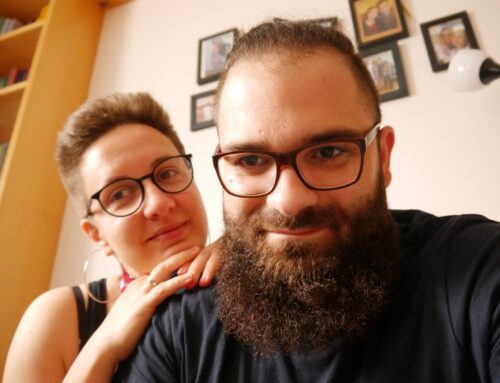
It’s not a given to have someone like Marko by your side, and I’m fully aware of that. Not only by observing the relationships of people around me, but also through my own experiences from my “previous life” (since I count time as before Marko and Marko), I’ve realized that in relationships, nothing should ever be taken for granted.
It’s not enough to want a good relationship and hope it will just happen. A meaningful relationship has to be built — and maintained — through mutual effort and, often, even greater perseverance.
There is no magical moment when things reach a fairytale peak and stay forever perfect on that enchanted hill.
“And they lived happily ever after” is an absolute lie — and a comforting illusion.
That doesn’t mean it’s impossible to be happy in a relationship; it means that a good relationship requires constant work and dedication from both partners.
And no, that doesn’t mean there are never disagreements. Quite the opposite — they exist even in the best relationships I know, including my own. The difference lies in how they are handled.
Now that we’ve cleared that up, let me shatter another illusion: there is no recipe for a “perfect” marriage or partnership.
Every relationship is unique and special — just like the individuals in it. What works for us doesn’t necessarily work for you. The same goes for parenting.
That doesn’t mean we shouldn’t share our experiences. In fact, the more we lay things out on the table and talk openly about them, the more we break through the veil of mystery surrounding this so-called “perfection.”
We all know perfection doesn’t exist, no matter how hard the media — especially social media — try to convince us otherwise.
We are all absolutely perfect and completely imperfect in our own ways. And so are our relationships.

What truly matters in a relationship
What matters most to me in a relationship is how I feel when I’m with someone.
No, that doesn’t mean it’s realistic to be happy 24/7, nor that others are responsible for our emotions.
Philippa Perry emphasizes this beautifully in her book The Book You Wish Your Parents Had Read (and Your Children Will Be Glad That You Did).
She argues that it’s essential to take responsibility for your own emotions instead of blaming others for them, and she highlights the importance of self-awareness and reflection — especially in the parent-child relationship and in partnerships.
What matters to me is whether your partner pushes you forward or trips you up at every step.
Do they give you wind beneath your wings, or do they make you shrink yourself to fit them?
Do they give you space to be who you are, or do they try to mold you to their liking?
For me, it’s crucial to feel seen — not to have to hide my ambitions, opinions, convictions, or even my defiance.
To feel good in my own skin and to have my partner accept, support, and nurture that.
Lessons from past relationships
Sadly, I didn’t always know how important all that is — I learned it, of course, through my own mistakes in past relationships that didn’t work out.
There were men in my life who simply didn’t see me, who couldn’t handle my strength, intelligence, or ambition.
Nothing against my exes — truly. In fact, I’m grateful for all those experiences, because they taught me what I don’t want in life and that I’m capable of more — and better.
One of them not only failed to support my ambitions — next to him, I felt guilty for my successes, as if my task was to make myself smaller so that he wouldn’t feel bad or threatened.
That showed itself especially in college — I was thriving, finishing everything on time, receiving scholarships for exceptional achievement — while he struggled to pass exams and had been stuck since his first year.
Every one of my top grades felt bitter because he had failed yet again. He never explicitly said words to make me feel that way, but his behavior made it clear.
And society reinforces that message from early on — women are taught to listen to men, to support them; “behind every successful man stands a woman who supports him”; “you should never beat a man at a game or sport.” Everyday life is full of clichés that program us to automatically shrink ourselves, to avoid threatening male superiority — even when it doesn’t exist.
For example, I’d want to celebrate my new scholarship, and he’d conveniently be “grounded” at home because he’d failed another exam. When I talked about my dream of becoming a sports journalist, he’d say that’s not a job for a woman because I’d be away too often.
I had to pull him along, cheer him up, motivate him — and constantly make myself smaller. And of course, in that kind of relationship, you eventually stop feeling good.
When it’s not working for you — get out.
The next one didn’t last long, but it was long enough for me to realize he held the same typically Balkan views on women and relationships: women should bear children; men can do whatever they want.
Not for me, thanks.
The third one — the “maybe we will, maybe we won’t” type — never believed in my writing or in my idea that I could “change the world with words.”
“That’s impossible. You won’t make it,” he’d say, often with a smirk.
Even the last time we spoke, years later, he joked stupidly: “When I saw it was about someone with a blog, I figured it must be you. So, have you changed the world yet?”

A partner who nurtures your flame
I’ve always had that spark — the need to express myself, to fight injustice with words, to empower and encourage others to wake up and start living by their own rules.
With Marko, that spark became a flame — one he’s been keeping alive and bright for the past 13 years since his first “yes.” He’s always believed in me and my writing, sees things in me that I don’t even see myself, and helps me recognize them.
Because of him, I have a whole collection of writing pens — from real bird feathers to glass and calligraphy pens. When I finished my master’s degree, he bought me a typewriter with a Cyrillic keyboard — something I had dreamed about for years.
Maybe that doesn’t sound impressive, but we live in Germany — finding an old typewriter at a flea market is easy enough, but finding one in Serbian Cyrillic? Nearly impossible.
And yet, he did.
Every time I falter, he’s there — offering his hand, lifting me up.
He sees potential in me that I sometimes can’t see, nurtures it, and encourages me to follow it.
And I know very well that this kind of support is anything but self-evident.
There are too many examples — even among people close to me — that show how Marko is more the exception than the rule.
When support is missing
A close friend of mine — a brilliant woman, mother, and friend — unfortunately lives with a man who, after she finished her degree in media studies, suggested she take a course to become a kindergarten teacher, because that “made more sense for a woman.”
I saw her again a few months ago, and she told me shyly:
“You know, I’ve started working 20 hours a week at my son’s school, and it makes me so fulfilled.”
“Wow, that’s amazing — I’m so happy for you,” I said, genuinely excited.
“Yes, everything at work is great, but at home not a day goes by without my husband complaining that there’s no need for me to work, that I should focus more on the house and our son. But what am I supposed to do while he’s at school? Clean, wash, and cook all day? I do all that — but I can’t do only that. I don’t understand how he doesn’t see it… I keep wondering how he’d feel if he were tied to the house the way he expects me to be…”
That breaks my heart on so many levels.
It saddens me that an educated, dedicated woman and mother has to justify her desire to have a job outside the home.
That she feels guilty for finding fulfillment in something that interests her, while the person who should be her closest ally and first source of support doesn’t see how deeply she needs it.
And she’s not the only one.
At the same time, stories like hers remind me how important it is to appreciate having someone who doesn’t hold you back — someone who supports and helps you move forward.
When partners grow at different speeds
Another kind of danger in relationships comes from the same source but has a different outcome.
When one partner is growing and the other stagnates, an unbridgeable gap eventually forms.
That’s why it’s important not only to see your partner and support their aspirations but to keep pace with them.
That doesn’t mean we must have the same interests or do everything together — individuality is crucial in any relationship. But there has to be some kind of balance.
For example: if a woman starts training regularly to stay fit and healthy, goes to therapy, or joins workshops to understand herself better, while her partner mocks her, refuses to get off the couch, and overeats while watching football — that imbalance will inevitably take its toll.
Between two people who once shared goals, interests, and deep affection, it’s only a matter of time before one realizes that “something no longer feels right.”
At that point, there are two paths: either you shrink yourself again to “return” to the level of the stagnant partner, or you realize that you can do better — and differently.
It’s crucial to understand that trying to change your partner is doomed from the start; you can’t reshape another person to fit your expectations.
But what is possible is to inspire each other — to show by example that things can improve.
Mel Robbins calls this the principle of “Let them, then let me” — let others be who they want to be, but allow yourself to become who you want to be, your best version.
Mel says that if open communication doesn’t bring results, lead by example, show that it can be better, and give yourself and your partner six months for things to change.
In our example, there are two possible outcomes: either the stagnant partner wakes up, watching his wife bloom, and decides to follow her lead to restore balance — or he takes the “easier path,” stays on the couch, mocks her for changing, and blames her for the growing distance between them.
If six months go by and nothing changes, then it’s time to be honest with yourself and make a decision: is this a deal-breaker or not? Make it work — or walk away.

A healthy relationship is possible
Everything I’ve said doesn’t mean that having a healthy, fulfilling relationship today is impossible. Quite the opposite.
My best friend Sara is very successful in her career, a mother of two wonderful girls, and the wife of an ambitious scientist. Together, they make everything look easy and natural.
Jake is the one who gets up early, makes breakfast for the girls, takes them to school, and picks them up. Sara’s work schedule is unconventional, so he’s usually the one cooking dinner and reading bedtime stories. She, on the other hand, is the one financing the family and enabling her husband to do what he loves most.
And it works — beautifully.
So what’s their secret? Of course, I asked Sara directly, and she answered casually:
“Communication, trust, and a sense of humor. Good communication and no ego — we’re partners, a team, a family. And a team sticks together.”
No one has described the essence of true love — and, I’d add, of a functional relationship — better than bell hooks. In her book All About Love, she writes:
“We usually imagine that true love will be intensely pleasurable and romantic, full of light and warmth. In reality, true love is based on work. (…) The essence of true love is mutual recognition — two people seeing each other as they really are. (…) Entering such a relationship is frightening precisely because we feel there’s no place left to hide. We know each other. All the ecstasy we feel arises as this love nourishes us and at the same time challenges us to grow and change. (…) True love is unconditional, but for it to truly flourish, it requires continuous commitment to constructive struggle and change.” (hooks, All About Love, pp. 112–113)
A relationship is a two-way street — a balance of giving and receiving. A seesaw where, for a time, one is up and the other down.
What matters is that the seesaw keeps moving — not that it stays still. Because if it does, there’s no relationship anymore — just disconnection, which sooner or later turns into alienation.
Sincerely,
S-Mama




Leave A Comment