
No, this isn’t one of those texts where I lecture you about protecting the environment. Or is it?
Why the need to write this at all? Not to show off how great I am, but to show that every single one of us can make small changes to their everyday routine that can have a big impact – first on our immediate surroundings, and then on the whole planet.
It’s simply not true that none of us as individuals can make a difference.
I have to admit that my environmental awareness has grown a lot since I’ve been living in Germany – and even more since I became a mum.
As mothers, we carry even greater responsibility and need to think much more actively about what kind of planet we’re leaving our children.
When I still lived in Serbia, my environmental efforts amounted to a few “basic” small things – turning off lights in rooms you’re not in, turning off the tap while brushing your teeth or washing your face, throwing rubbish in the bin(!) rather than on the street, and keeping it in your bag or pocket until you find one – that kind of thing.
What I’m most proud of is the part of my “engagement” that connects to my greatest passion – books. Not only have I mostly borrowed the books I read from the library, but when I finally had the chance to buy my own, I always tried to buy ones with the FSC label, which means they were printed on recycled paper or produced from responsibly managed resources. That has always mattered to me (and still does).
But all of that isn’t enough. In this and the texts that follow in the coming weeks, I’ve listed some of the biggest culprits – and ways to get rid of them, or at least reduce their use to start with.
Today I’m hitting where it hurts the most – bags and cars.
Plastic Bags
Start carrying shopping bags in your handbag and saying NO TO BAGS in shops. Realistically, there are so many beautiful and practical reusable bags today that take up very little space in your bag – no matter how small it is – and they’re not expensive either. And by refusing bags, you’re doing something BIG for our planet.
Maybe it seems easier to just take the free bag at the shop. But it’s not free – it costs us far more than we can imagine. No, it’s not world conspiracies or phone masts or similar nonsense that are responsible for us no longer knowing when it’s summer or winter, and for extreme temperatures – it’s us, our habits, and our beloved BAGS.
Bags haven’t always been part of our lives – they only became standard about ten or fifteen years ago. I still remember how my grandmother, for as long as I can remember, always went to the shop with a cloth bag or a basket.
Have we really become so lazy that it’s too much effort to bring our own bags? I don’t believe that.
Just as bags entered our shops and our lives, we need to push them back out. Every single one of us can say NO to bags – and there will be more and more of us. It’s not impossible. Give it a try.
Germans carry bags, baskets, whatever they prefer or happen to have. And honestly – it’s absolutely stylish. Yes, bags are available at checkouts, as are cloth bags, but they cost money. If someone forgets their bag at home, they can buy one – but trust me, a German will do that extremely reluctantly, because why spend money on something you don’t have to. It’s not that they’re stingy – it’s that they spend their money consciously and don’t waste it where they don’t need to.
Cars
We don’t have a car, and we have no plans to buy one in the near future. For one thing, it’s simply not on our list of priorities – and for another, why pollute the environment more than necessary when we don’t have to.
When the weather is good (March to November) we get around the whole city by bike – and when the weather is bad, we use public transport or trains when we’re travelling further.
Not only are city traffic jams significantly reduced because everyone cycles, but the air is much more pleasant and cleaner too, as vehicle emissions decrease year on year. That the Germans take this seriously is also proven by the recent diesel vehicle bans in some cities.
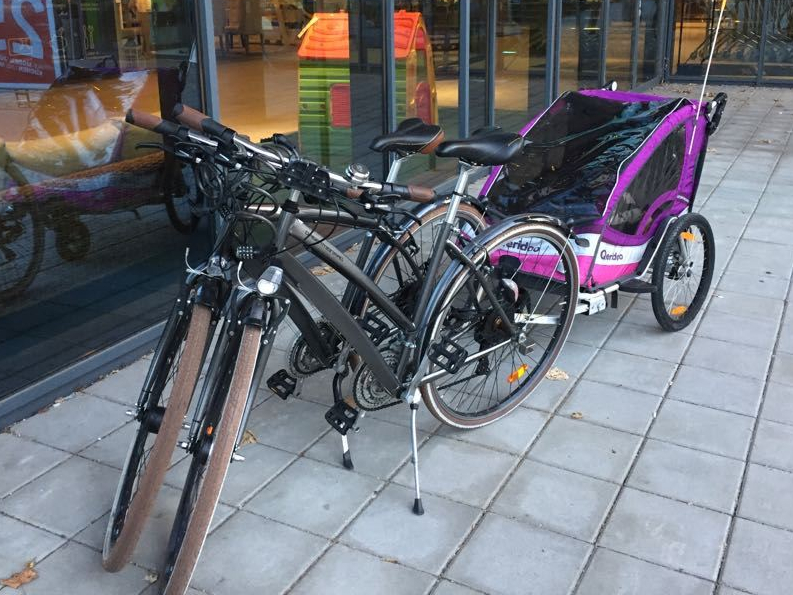
This is our “car”.
I know, you’ll say “easy for you, you’re in Germany.” That’s true. But the fact is that I developed my transport habits back when I still lived in Niš, where I walked almost everywhere. So sorry, but that kind of excuse doesn’t fully hold up.
Besides – if you really do need to use a car, try to keep it to an absolute minimum. For example, arrange with colleagues to share petrol costs and take turns driving to work or university each week. Because why should everyone come in their own car when three or four people could use just one? You’re not only helping the planet – you’re saving money too, and it’s so much more fun when you’re in company.
On top of that, not using a car has direct positive effects on your physical health. If you don’t have the time (or motivation) to spend several hours a week at the gym, walking to work, to the city, to kindergarten – or better still, cycling – will do far more for your physical health than you might imagine.
I, for example, didn’t exercise after giving birth – but I did walk every day and used my bicycle as my main mode of transport. In about a year, I lost the excess weight that had accumulated during pregnancy that way. Healthy, ecological, and practical. Everyone wins.
No Higher Mathematics. Just a Question of Habit.
The takeaway is: you don’t need to be German, Chinese, or anyone else to care about your environment.
From others we can pick up and learn good habits that we didn’t have before – habits we didn’t even realise were harmful until someone pointed it out.
Isn’t it nicer for us too, to live in a clean environment with fresh air – even in the city?
It’s not rocket science – just a matter of habit. And habits can change.
Yes, it’s possible. Even for the better.


Leave A Comment