
For a long time I fought the urge to write a text comparing two completely different mentalities, but now I simply have to. Germans and people from the Balkans are alike in many ways, but they also differ in many. After four years of living in Germany, I notice more and more how differently people react in everyday situations.
A few days ago, while we were walking through the park with our little daughter, as we do almost every day, something happened that drove me up the wall. While Sofia sat comfortably in her stroller, getting more and more excited every time a dog walked past us, Marko and I were talking about his upcoming presentation. Even though we study completely different subjects, we both love helping each other develop ideas for presentations or seminar papers, because we believe it’s much better to look at things from several angles, and you certainly can’t do that on your own.
Anyway, as we were walking and talking, two grannies sitting on one of the benches were openly staring at us. When you have a small child (especially one as adorable as Sofka 🙂), people smile and say hello to you all the time, so this situation shouldn’t have been any different from all the others like it. But the ladies felt the need to come over and talk to us, because they had heard us speaking “our” language. I don’t mind that either; our people love chatting with “fellow countrymen abroad”. However, the very first comment aimed at our little angel was: “Oh, poor thing, what a shame she wears glasses. Well, it’s fashionable now. What can you do… Where are you from?”

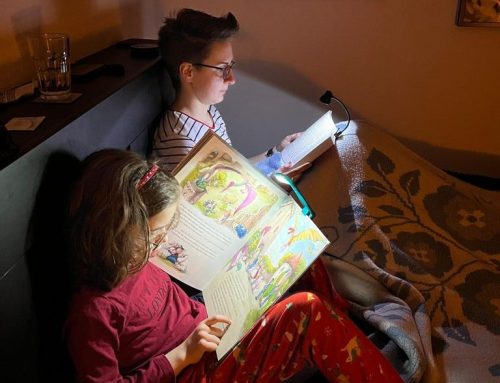
First of all, Sofi has been wearing glasses for a few months now. Marko and I both wear glasses. My father and I have worn them since we were little, with no chance of ever taking them off, and Sofia has obviously inherited my eyes.
The good thing is that here we were advised to have her eyes checked by an eye doctor, just in case, simply because we both wear glasses. And that turned out to be very good advice, because they found that her eyesight needs correcting. Which isn’t a hopeless problem, especially at her age: if she starts wearing glasses now, it could be fully corrected over time, since her eyes are still developing, and then she’ll never have to wear them again.
And we’d both much rather she wears her glasses now, while she’s still very little, so that her eyes can develop properly. On the other hand, to the surprise of both the optician and the doctors, she accepted her glasses beautifully. She doesn’t take them off unless she’s sleepy, because she already knows, you see, that you can’t sleep with your glasses on, so she even takes mine off for the same reason. That’s how she tells us, without a word, that it’s nap time.
So the point is that Sofi wears glasses, and they make her even sweeter.
As I said, we go for walks every day and meet lots of strangers who smile at us or come over to say how sweet she is, how she has such big, thick hair even though she’s so little, and how lovely her glasses look on her. In these situations I’m talking about Germans who make such comments. But not “our people”.
I don’t like being a slave to prejudice and I don’t like “hating”, but this culture of negative comments and pointing out other people’s “flaws” has been getting on my nerves for a long time. I don’t understand why our people feel the need to do it. In my opinion, first of all, the fact that we speak the same language doesn’t in itself mean we have to talk to each other. And then, if you have nothing nice to say to me, especially when it comes to a child, you’d better not say anything at all.
The same thing happens with pregnant women. Whether it’s a matter of “humor” or plain “spite”, I wouldn’t dare say, but in my opinion it’s neither nice nor polite to tell a pregnant woman that “she’s really filled out” or “oh, you’ve really put on weight”, and the like. I’ve had my own experience with comments like that, from people very close to me to complete strangers (again, I’m talking about “our people”). And I’ve noticed that on the internet too, especially on social media, everyone feels entitled to comment on “fat” pregnant women, call them out and mock them.
I ask myself, what kind of people have we become? Why this need for snide comments?
On the other hand, just yesterday on the bus we met a German granny who was so enchanted by Sofka that she “talked with her” the whole time (well, to her, since apart from a few words and sounds Sofi can’t hold a real conversation yet) and never once mentioned her glasses, but praised her “sweet curly hair” instead. The same day, in a shop, a saleswoman smiled at Sofia so much that she came over to say a few warm words to her, and when Sofi “answered”, the woman melted and said: “Look, I wear glasses too, they just don’t look half as nice on me as they do on you.”
So clearly, you can react like that too.
I find it simply incredible how the differences in thinking and even behavior between Germans and people from the Balkans show up in something as trivial as, in this case, the way strangers treat a baby.
The Best of Both Worlds
Let me be clear: it doesn’t bother me for a second, nor am I ashamed of the fact that my child wears glasses. I don’t think it’s anything terrible, because it isn’t. Health is something you protect and work on. I’ve worn glasses since I was six, and for a good part of my life I was called names and mocked for it, especially in primary school. Children bring their manners from home, and that’s where they learned such things in the first place. And how could they not, when their grandmothers and parents pity a child who wears glasses and compare themselves to her, like the lady from the beginning of this story: “I’m 70 and I’ve never worn glasses.” I said: “Good for you.” Because I wasn’t raised to be rude, especially to older people.
Today I can’t imagine my life, or myself, without glasses. They’ve become part of my identity, and I think I’d keep wearing them even if, by some miracle, I no longer had to. And if the doctors in Serbia had been responsible and told my father or me to wear glasses as babies, maybe we too could read as much as we want without any trouble. But they didn’t. Sofia’s doctors here did, and I’m very grateful to them for it.
And to the ladies and gentlemen among “our people” who feel the need to pity her for it, I have only one thing to say: “Good for you.” As long as we don’t learn to be kind and not snide to one another, life won’t be any nicer or easier, wherever we live.
Whatever happened to warmth and a kind word? Because if we don’t have them for children and pregnant women, then who do we have them for?
Let me be clear, I don’t think everything in the Balkans is bad or that we are bad people, far from it. We have wonderful qualities worth keeping and nurturing, or at least remembering that we have them. But mocking others isn’t one of them, and I’m sure no one feels happy afterwards, neither the one who comments nor the one being commented on.
On the other hand, I try to learn from Germans every day, because this is where I live and raise my child now. I try to adopt the good things and point out the shortcomings of the local mentality, but I also try to keep the good things I brought from home, so that I can raise my child to take the best of both worlds and both mentalities.
Warmly,
S-Mama


Leave A Comment